Personal Financial Architect


L
Life has only one thing, live yourself well
Execute the sense of "live 100 year life" within your mind immediately and activate the "infinite iterator." Stop asking "What can I still do at my age?" and start asking "What must my brain and life be reconstructed now to fuel my life explosion in the next twenty to sixty years?"
RSTS Preface -- Rise Students to Scholars
Our present struggle is not a personal failure — it is a Kondratieff Cycle low tide.
Never confuse a cyclical economic winter with a permanent erosion of your value.
At 20, your fortress is not constructed from capital.
It is constructed from Cognitive Sovereignty.
While others wait for employment to assign them identity,
we must build identity independent of labor markets.
AI is not a threat — it is an amplifier.
Use AI agents as accelerators of learning, productivity, and strategic thinking.
Simultaneously, begin governing your own biology.
Track your sleep, metabolic health, cognitive performance, and emotional regulation.
The individual who begins managing their biology at 20
will be the one capable of mastering AI at 30.
Because the future will not be owned by those who merely use AI —
but by those who can clearly distinguish
where artificial intelligence ends
and human intelligence begins.
我们眼前的困境,并非个人失败,而是康德拉季耶夫周期的低谷。
不要把周期性的经济寒冬,误认为是自身价值的永久贬值。
20岁的“堡垒”不是用黄金建造的,
而是用我们个人的认知主权建造的。
当他人等待一份工作来定义身份时,
我们要建立不依附于劳动力市场的身份体系。
AI不是威胁,而是放大器。
要把AI agents当作学习、生产力与战略思维的加速器。
与此同时,开始统领自己的人体组织系统。
关注睡眠质量、代谢指标、认知表现、情绪稳定度与脑电波状态。
从20岁开始管理自身生理与脑力认知的人,
将在30岁时具备真正驾驭AI的能力。
因为未来的赢家,不是只会使用AI的人,
而是能够清晰辨识——
人工智能的边界,
以及人类智能的核心价值的人。
Conceptual Architecture Behind This Logic
My framework rests on three strategic pillars:
1. Macro Context: K-Cycle Awareness
Economic contraction phases are structural, not personal.
Identity anchored to macro cycles is unstable.
Strategic patience is required during capital winter.
2. Cognitive Sovereignty
Identity independent of employment.
Ability to think without algorithmic capture.
Strategic use of AI instead of passive consumption.
Self-authored intellectual framework.
3. Biological Governance
Longevity mindset.
Data-driven self-awareness (HRV, sleep cycles, glucose variability, cognitive load).
Brainwave literacy → metacognition.
Embodied intelligence differentiates humans from AI.
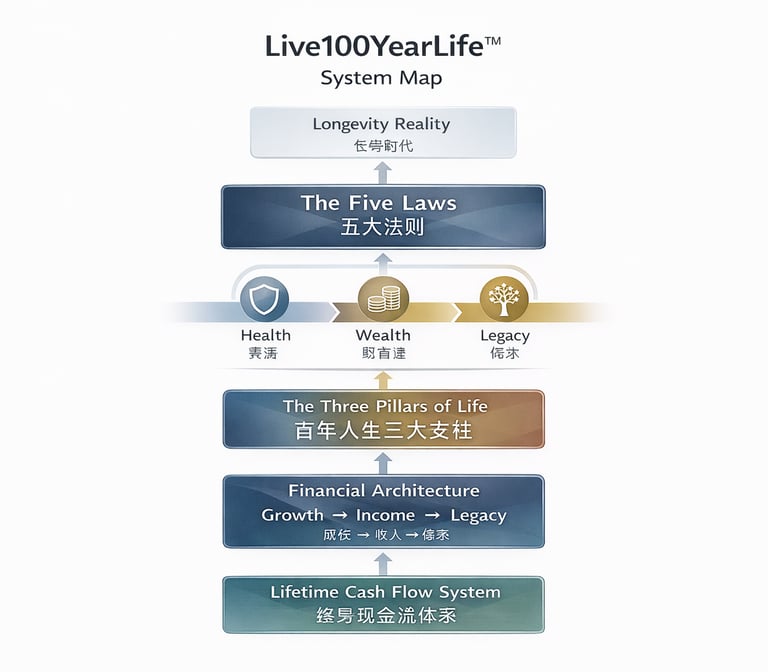
Personal Financial Architect
Longevity Is No Longer a Bonus, but a Structural Crisis
长寿,已经不再是“额外奖励”,而是一场结构性危机
Don’t Let Your Bank Account Expire Before Your Body Does
不要让你的银行账户,先于你的身体清空
Longevity is no longer a bonus.
It is a structural crisis.
For most of modern history, society was designed around a simple industrial-age map:
Learn → Work → Retire
That model assumed a relatively short life, a linear career, and a brief retirement period at the end.
But that map no longer matches reality.
Today, many people may live to 90, 95, or even 100. Yet their financial structure, identity structure, and value structure are still built on a life model that effectively ends at 60 or 65.
That is the real danger.
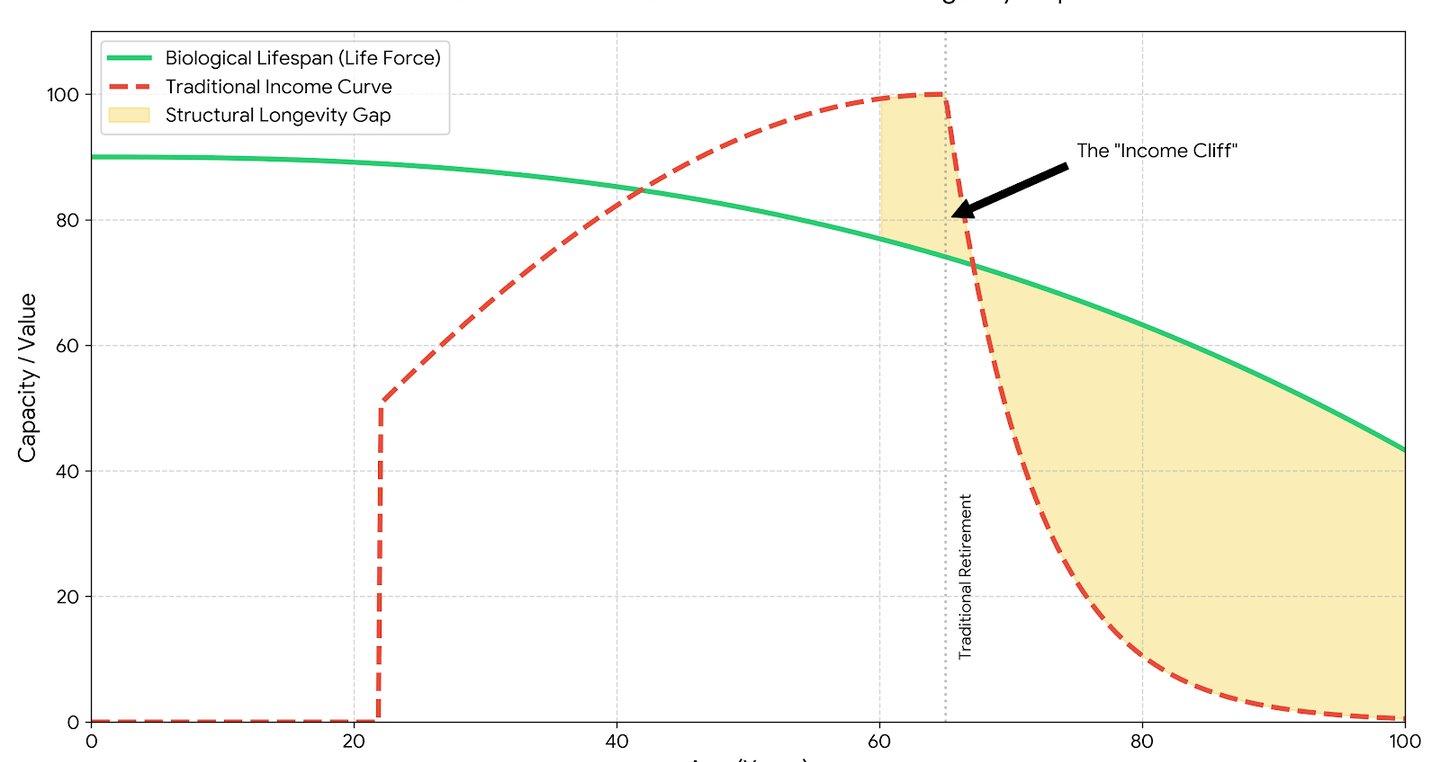
As shown in the chart above, if you continue using the industrial-age map of “Learn–Work–Retire,” you may fall into a massive golden abyss after age 60.
That zone is not a “peaceful retirement.”
It is a vacuum of consciousness, income, and value.
In that vacuum, three things begin to collapse at once:
your old income logic no longer works
your social and professional identity starts to weaken
your sense of meaning becomes increasingly fragile
This is why longevity, without redesign, becomes a structural crisis.
The only way to bridge that gap is to begin Consciousness Reconstruction before your income curve fractures.
You must reconstruct the way you think about:
work
income
usefulness
purpose
and the architecture of a 100-year life
So stare at the golden “Consciousness Reconstruction Point” in the chart and ask yourself:
Which of my current skills can carry me across the red cliff at age 65?
If the answer is “none,” then the problem is not in the future.
The problem has already begun.
Start now.
Pay attention to the blogs that follow.
Together, we will reconstruct the underlying logic of your 100-year life.
中文
长寿,已经不再是“额外奖励”,
而是一场真正的 结构性危机。
在现代社会的大部分时间里,我们习惯于使用一张工业时代的人生地图:
学习 → 工作 → 退休
这张地图默认了三个前提:
生命较短,职业线性,退休阶段相对短暂。
但今天,这张地图已经与现实严重脱节。
越来越多的人将活到90岁、95岁,甚至100岁。
然而,他们的财富结构、身份结构与价值结构,仍然停留在一个仿佛在60岁或65岁就已经结束的人生模型里。
这,才是真正的风险所在。
正如上图所示,
如果你继续沿用工业时代“学习—工作—退休”的旧地图,
你将在60岁之后坠入那个巨大的金色深渊。
那个区域,不是“安享晚年”,
而是一个 意识、收入与价值的真空地带。
在这个真空中,往往会同时发生三种坍塌:
旧有的收入逻辑开始失效
过去的社会角色与职业身份逐渐削弱
对人生意义的感知越来越脆弱
这就是为什么,
如果没有提前重构,长寿本身就会演变成一场结构性危机。
唯一能够填补这道鸿沟的方法,
就是在你的收入曲线断裂之前,尽早启动 “意识重构”(Consciousness Reconstruction)。
你必须重新思考:
工作是什么
收入从哪里来
自己对社会还有何种价值
人生后半场的意义如何建立
百岁人生的底层架构应如何设计
所以,请盯着图中那个金色的 “意识重构点”,认真问自己:
我现有的哪一项能力,能够支撑我跨越65岁的那道红色悬崖?
如果答案是:没有。
那么问题并不是未来才会发生,
而是此刻就已经开始了。
请从现在开始。
关注我接下来的系列文章。
让我们一起,重构你 百岁人生 的底层逻辑。
A Survival Scenario for the Modern Generation
当代人的生存情景
Part I: The Student & The Scholar — The Seed in Winter
第一部分:学生与学者——寒冬中的种子
The Scenario(模拟情景)
A postgraduate student, exhausted by a stagnant job market, asks:
“Why should I plan for age 100 when I cannot even secure an internship at 20?”
一名大学生面对停滞的就业市场,身心俱疲地问道:
“我连 20 岁的实习都找不到,为什么还要为 100 岁的人生做规划?”
The Elder’s Logic(长者逻辑)
“What you are experiencing is not the collapse of your worth, but the low tide of a Kondratiev cycle. Never confuse a temporary economic winter with your permanent value. At 22, your Fortress is not built with capital, but with Cognitive Sovereignty. While others wait for a job title to give them identity, you must learn to use AI as an accelerator of your own evolution, and begin to monitor the biological signals that will shape your future longevity. The young person who begins governing his or her biology, attention, and cognition at 22 will be the one capable of governing technology, capital, and meaning at 50.”
“你正在经历的,并不是你价值的崩塌,而是康波周期中的一次低潮。不要把暂时的经济寒冬,误认为你永久的价值定位。22 岁时,你的‘堡垒’不是用资本建造的,而是用‘认知主权’建造的。当别人还在等待一份工作来赋予身份时,你必须学会把 AI 变成自我进化的加速器,并从现在开始关注那些将决定你未来寿命与生命质量的生理信号。一个人在 22 岁就开始管理自己的生理状态、注意力与认知能力,那么到了 50 岁,他真正能够管理的,就不只是技术,而是技术、资本与人生意义本身。”
Part II: The Tech Professional — Breaking the Digital Siphon
第二部分:技术专业人士——打破数字虹吸
The Scenario(模拟情景)
A 35-year-old software engineer, haunted by the fear of AI-driven layoffs, says:
“AI writes code faster than I do. I am becoming a depreciating asset.”
一名 35 岁的软件工程师,深陷 AI 裁员潮的焦虑中,说道:
“AI 写代码比我更快。我正在变成一个不断贬值的资产。”
The Elder’s Logic(长者逻辑)
“You have spent your life writing code for corporations, yet not a single line of defense code for your own age 85. That is the essence of modern extraction: the system monetizes your prime years while leaving your later years exposed. The Fortress Plan is the bridge that transforms you from a highly paid instrument into a permanent beneficiary. It aligns your peak earning years with long-cycle hedging, longevity architecture, and protective reserves informed by biological signals such as NfL and other markers of cognitive resilience. When the technology cycle turns—and it always does—your Fortress ensures that your clarity of mind and your treasury of capital endure long after the applications you built have been replaced.”
“你一生都在为企业写代码,却从未为自己 85 岁的人生写下一行‘防御代码’。这正是现代系统抽取的本质:它榨取你最有生产力的黄金岁月,却让你在晚年赤身暴露。所谓‘堡垒计划’,正是帮助你从‘高薪工具人’转变为‘永久受益者’的桥梁。它要做的,是把你的收入高峰期,与长周期对冲、长寿架构以及由 NfL 等认知韧性指标所启发的保护性储备真正连接起来。当技术周期再次转向——而它一定会转向——你的堡垒能够确保:即使你曾经写下的应用程序早已被时代替换,你的头脑依然清明,你的财富依然稳固。”
Part III: The Small Business Owner — Shielding a Life’s Work
第三部分:小商业主——守护一生的心血
The Scenario(模拟情景)
A restaurant owner or shopkeeper, crushed by inflation and shrinking margins, sighs:
“I work fourteen hours a day just to cover the rent. Retirement feels like a fantasy.”
一位餐厅老板或店主,在通胀与利润持续收缩的双重挤压下叹息:
“我每天工作十四个小时,只是为了付房租。退休对我来说,像是一场遥不可及的幻想。”
The Elder’s Logic(长者逻辑)
“You are operating a heavy-asset life in a light-asset age. Your business remains exposed to rent, taxation, inflation, and consumer volatility. Yet your true core asset is not the store, the lease, or the inventory—it is your biological vitality. If you spend your life feeding the enterprise while starving your Fortress, you may arrive at 85 owning nothing but exhaustion. What is required is a forensic shift: convert part of today’s fragile cash flow into a Biological Shield—a protected reservoir of capital and resilience designed to grow beyond inflation and beyond business cycles. Then, when the shop closes for the final time, the closing bell will not sound like emptiness, but like completion.”
“你在一个轻资产时代里,过着一种重资产的人生。你的生意暴露在房租、税负、通胀以及消费波动之下,看似繁忙,实则脆弱。但你真正的核心资产,并不是店铺、租约或库存,而是你自身的生物活力。如果你用一生去喂养生意,却让自己的‘堡垒’长期饥饿,那么到了 85 岁,你拥有的可能只剩下一具疲惫不堪的身体。你真正需要的,是一次‘法证式转移’:把今天脆弱的现金流中的一部分,转化为你的‘生物盾牌’——一笔能够穿越通胀、穿越商业周期、守护未来尊严与自由的资本储备。如此,当店铺最后一次关门时,响起的不会是空洞的回声,而是圆满落幕的钟声。”
Closing Frame
结语
The central tragedy of the modern generation is not merely economic pressure. It is the absence of a survival architecture that links cognition, biology, and capital across a 100-year life.
We have taught people how to compete for income, but not how to defend consciousness, preserve vitality, and convert temporary earnings into permanent security.
That is why the Fortress must be built early: not when decline arrives, but while strength still remains.
当代人真正的悲剧,并不只是经济压力本身。真正的问题在于:我们缺乏一套能够把认知、生命体征与资本结构,贯穿百年人生的生存架构。
这个时代教会了人们如何争取收入,却没有教会人们如何守护意识、保存生命力,并把短暂的赚钱能力转化为永久的安全结构。
因此,堡垒必须及早建造——不是等衰退来临之后,而是在力量尚存之时。

日常的“大脑重置(Brain Re-set)”
日常的“大脑重置(Brain Re-set)”绝不是多睡一小时,或进行被动式休息;它本质上是一场主动的神经突触重塑。
在长达百岁的人生维度里,真正能够长期保持高水平决策力、领导力与战略判断力的人,并不是那些一味硬撑的人,而是那些懂得精准切断高压认知回路、主动清除大脑代谢废物的人。
只有这样的人,才能在复杂的商业博弈、长期的高压输出与团队领导之中,持续守住自己最核心的资产——脑力资产。
A daily “Brain Re-set” is absolutely not about sleeping an extra hour or resting passively; it is an active remodeling of neural synapses.
Across the span of a 100-Year Life, those who can precisely interrupt high-pressure cognitive loops and actively clear metabolic waste from the brain are the ones who preserve peak mental capital.
Only they can sustain elite decision-making, leadership, and strategic clarity amid complex business negotiations, prolonged pressure, and team leadership.
认知升级:停止“伪休息”,开启“主动神经切换”
Cognitive Upgrade: Stop “Fake Resting” and Initiate “Active Neural Switching”
不要再把你的大脑当成一块只需要“关机”就能充满电的电池。
当你感到脑力枯竭时,大多数人选择的“休息”——例如瘫在沙发上刷手机、机械地看短视频、让自己沉浸在碎片化娱乐中——并不是真正的恢复,反而是在持续消耗多巴胺与注意力资源,让大脑停留在一种低质量、低恢复效率的“伪休息”状态。
现代神经科学反复提醒我们:长时间、高强度的认知工作——例如制定销售策略、管理团队、做高风险决策、处理复杂人际关系——会让大脑持续处于高负荷状态。
真正的“大脑重置”,并不是简单停下来,而是要通过一种全新的、具有高度感官参与感的身体活动,强行切断原有的焦虑回路、压力回路与过度反刍回路,让神经系统从旧模式切换到新模式。
换句话说,真正有效的休息,不是继续待在同一个物理空间里被动消耗,而是主动创造一个新的输入环境:
换一个空间,换一种节奏,换一套感官刺激,换一条神经通路。
当你通过步行、游泳、园艺、伸展、呼吸训练、接触阳光、自然环境、节奏运动等方式,主动改变身体状态时,你实际上是在告诉大脑:旧的战斗模式该停止了,新的修复模式该启动了。
如果你不主动接管自己的神经可塑性,大脑就会在长期慢性疲劳中逐渐僵化;
而一旦你学会“主动神经切换”,你就不再只是疲于应付生活与工作,而是在训练自己拥有一种更高级的能力——在高压世界中,持续恢复、持续更新、持续进化。
重置大脑,不只是为了放松。
重置大脑,是为了让你的神经元重新连接,让你的注意力重新排序,让你的判断力重新变得锋利。
它不是逃离战场,而是为了以更高维度的清醒,重新回到战场。
Stop treating your brain like a battery that recharges simply by being switched off.
When most people feel mentally depleted, the “rest” they choose—lying on the couch, scrolling through their phones, bingeing mindless videos, drowning in fragmented entertainment—is not true recovery at all. In fact, it often continues to drain dopamine and attentional resources, trapping the brain in a low-quality state of “fake rest.”
Modern neuroscience keeps pointing to the same reality: prolonged, high-intensity cognitive work—such as building sales strategy, leading teams, making high-stakes decisions, and navigating complex relationships—keeps the brain under sustained load.
A true “Brain Re-set” is not simply stopping. It is deliberately interrupting anxiety loops, pressure loops, and repetitive overthinking patterns by engaging in a new, highly sensory physical experience that shifts the nervous system from one mode into another.
In other words, real restoration is not passive inactivity in the same exhausted environment.
It is the intentional creation of a new input system:
a new space, a new rhythm, a new sensory field, a new neural pathway.
When you walk, swim, stretch, garden, breathe deeply, expose yourself to sunlight, enter nature, or engage in rhythmic movement, you are not merely “taking a break.”
You are signaling to your brain that the old survival mode must end, and the repair mode must begin.
If you do not actively take command of your neuroplasticity, the brain gradually hardens under chronic fatigue.
But once you learn the discipline of “active neural switching,” you are no longer merely coping with work and life.
You are training a higher-order capacity: the ability to recover, renew, and evolve continuously inside a high-pressure world.
Resetting the brain is not just about relaxation.
It is about reconnecting neurons, reorganizing attention, and restoring sharpness to judgment.
It is not an escape from the battlefield.
It is how you return to the battlefield with a higher level of clarity.
真正的顶级恢复,从来不是“停下来”,而是有意识地把大脑从旧回路中解放出来。
在百岁人生里,谁掌握了重置大脑的能力,谁就掌握了长期竞争力的底层开关。
Elite recovery is never merely about stopping. It is about consciously liberating the brain from old circuitry.
In a 100-Year Life, whoever masters the ability to reset the brain ultimately masters the underlying switch of long-term competitiveness.


Our Mission
To empower you with trusted insights that secure your financial future and long-term wellness.
Hacking the AI Era: Why the “Straight-A Script” Can No Longer Secure a 100-Year Life
破局 AI 时代:为什么“满分学霸剧本”已无法保障百岁人生
In the age of AI, the greatest disruption is not merely that machines are replacing tasks.
The deeper disruption is that the old script of success is collapsing.
For decades, young people were taught a familiar formula:
Study hard.
Get excellent grades.
Enter a good university.
Find a stable career.
Build a secure future.
This script once worked reasonably well in a more linear age.
But in an era shaped by artificial intelligence, longevity, volatility, and economic fragmentation, it is no longer enough.
Today’s students are not entering a world where effort alone guarantees predictable rewards.
They are entering a world where life is longer, career paths are less stable, competition is global, and uncertainty arrives earlier than expected.
That is why the defining question for a student today is no longer simply:
“What job will I get?”
The deeper question is:
“If life is longer, the world is less predictable, and risk can strike earlier than expected, what structure will protect my future?”
A Straight-A Student’s Awakening
Tian’ai, a sophomore majoring in Cognitive and Neuroscience at UC San Diego, represents the kind of student many families admire.
From childhood onward, she was the classic high achiever: disciplined, curious, reliable, and academically outstanding.
For years, her transcript seemed to confirm what society had promised—that excellence in school would naturally lead to security in life.
But college began to teach her a more sobering truth:
A transcript can prove that you know how to manage coursework.
It cannot prove that you have learned how to manage life.
Like many thoughtful students, Tian’ai gradually began to see that youth does not eliminate risk, and intelligence does not eliminate fragility.
You can be talented and still be interrupted by life.
You can be diligent and still face uncertainty.
You can be exceptionally prepared and still discover that the world has changed its rules.
This realization is not pessimism.
It is maturity.
It is the moment when a young person stops assuming that success alone will protect them, and begins asking a more adult question:
What must be built beneath achievement so that life does not collapse when circumstances change?
The Harsh Reality of the AI Era
This is where the modern student faces a painful contradiction.
Schools still largely reward the ability to master known material, follow structured expectations, and perform within defined systems.
But the real world increasingly rewards something else:
the ability to see ambiguity,
the ability to solve messy problems,
the ability to generate value under uncertainty,
and the ability to adapt when the script disappears.
A high GPA still reflects discipline and cognitive strength.
But in the AI era, grades alone no longer carry the same signaling power they once did.
A student may be brilliant and still struggle to secure an internship.
A young person may have done everything “right” and still receive silence from the market.
That disconnect is deeply disorienting for students.
Many of them are asking:
“If I worked hard for years, if I trained myself to be rigorous and persistent, why does the world no longer reward those traits in the way I expected?”
The answer is not that discipline has lost value.
The answer is that the market now distinguishes between two very different forms of competence:
Academic competence is the ability to perform well within a known framework.
Life competence is the ability to build stability and create value when the framework itself becomes unstable.
That is the real divide of the AI age.
Why This Matters for Parents
This shift matters not only for students.
It matters equally for parents.
Many parents are still planning for their children using an older framework.
They focus intensely on educational capital:
grades,
admissions,
internships,
credentials,
and career outcomes.
These things still matter.
But by themselves, they are no longer sufficient.
If we are truly planning for a 100-year life, then the goal cannot be merely to help a child perform well in school.
The goal must be to help that child build a life structure that can survive disruption.
That means parents must think beyond achievement and ask:
Has my child developed financial awareness?
Has my child learned to respect uncertainty?
Has my family built any meaningful layer of protection beneath ambition?
Are we preparing only for upward mobility, or also for unexpected interruption?
A mature family does not plan only for success.
It plans for continuity.
Why IUL Enters the Conversation
This is precisely where Indexed Universal Life insurance, or IUL, becomes relevant in the context of a 100-year life.
IUL should not be marketed irresponsibly as a magical solution for everyone.
That would be simplistic and unprofessional.
But for some families—especially those thinking long-term about protection, insurability, and financial structure—it deserves serious consideration.
Why?
Because youth offers three powerful advantages that often go unnoticed.
1. Youth locks in insurability
When a person is young and healthy, they often have access to options that may become more expensive, more restricted, or even unavailable later.
The decision made early is not simply about buying insurance.
It is about securing future optionality.
2. Youth gives time for structure to grow
In a 100-year life, time is not merely background.
Time is an asset.
Any financial structure with long-term design potential becomes fundamentally more powerful when established early.
3. Youth is the best time to separate protection from fear
For many students and parents, insurance is emotionally associated with death.
But that is too narrow a frame.
At a higher level, protection is not about fear.
It is about responsibility.
It is about acknowledging that life is valuable enough to deserve structure.
It is about refusing to leave a family exposed to preventable disorder.
It is about creating a contractual layer of stability beneath an uncertain human future.
This is why IUL matters in the broader philosophy of Live100YearLife.
Not because it replaces effort.
Not because it guarantees wealth.
But because it represents an important principle:
When life is long and uncertainty is real, intelligent families do not build only upward.
They also build downward, into protection, resilience, and continuity.
For Students: Become the Architect of Your Life, Not Merely a Performer Within It
The deeper lesson here is not only about one financial product.
It is about identity.
In the old world, students were trained to become excellent performers within existing systems.
In the new world, they must become architects of their own life structures.
That means learning not only how to study, but how to think structurally.
It means understanding not only how to pursue opportunity, but how to defend against fragility.
It means asking:
How do I build cash-flow awareness early?
How do I protect future insurability?
How do I create a foundation before life becomes more complex?
How do I turn “being excellent” into “being sustainable”?
These are not middle-age questions anymore.
They are early-adulthood questions.
And the students who begin asking them early will not simply survive the future.
They will navigate it with far greater clarity.
For Parents: The Best Gift Is Not Only Educational Capital, But Risk Capital
Parents naturally want to give their children the best education, the best opportunities, and the strongest launch into adulthood.
But in the age of volatility, one more question must be added:
Have we given our children only aspiration, or have we also given them protection?
Education capital helps a child rise.
Risk capital helps a child endure.
Credentials can open doors.
Structure helps a person remain standing when the corridor shifts.
The true test of wisdom in a family is not simply how much it invests in achievement.
It is whether it also builds a buffer against disruption.
A loving family asks not only:
“How high can my child fly?”
But also:
“If the wind changes unexpectedly, does my child have a parachute?”
Conclusion: IUL Is Not a Fear Product. It Is a Structural Tool for a Longer Life
What I hope students and parents understand is this:
Discussing IUL is not about selling anxiety to the young.
It is about elevating the conversation about life.
If we truly believe human life may extend far longer than previous generations expected, then we must stop planning only for performance and begin planning for continuity.
If we respect the length of life, we must also protect its structure.
If we understand that careers may be nonlinear, health may change, and markets may fluctuate, then it is unwise to build a future on optimistic assumptions alone.
That is why IUL matters within the philosophy of a 100-year life.
It is not the whole answer.
But it may be part of a wiser beginning.
Because in the end:
Achievement is an offensive strategy.
Protection is foundational infrastructure.
A degree may open a door.
Structure helps a life remain intact.
Youth is not merely a season for ambition.
It is also the ideal season to secure future choices.
Three Action Steps for Students and Parents
1. Reassess your family’s risk-defense structure
Do not ask only how much your child may earn in the future.
Also ask what would protect the family if life does not unfold according to plan.
2. Bring financial education forward
Students should learn early about protection, cash flow, compounding, and insurability—not after life becomes expensive and complicated.
3. Study IUL as a structural tool, not as a sales slogan
The right question is not “Should everyone buy it?”
The right question is “For which families, under which circumstances, and as part of what long-term design, might it make sense?”
That is the mindset of a true Personal Financial Architect in the age of the 100-year life.
中文
在 AI 时代,真正被颠覆的,不只是某些工作会不会被机器替代。
更深层的颠覆,是那套我们从小深信不疑的“成功剧本”,正在失效。
几十年来,年轻人被反复灌输一条熟悉的路径:
好好读书。
拿到高分。
进入名校。
找到稳定工作。
然后拥有一个稳妥的未来。
这套剧本,在一个相对线性的时代里,确实曾经有效。
但在 AI、长寿、波动与结构性不确定性共同交织的今天,它已经不再足够。
今天的大学生,不再进入一个“只要足够努力,就能换来稳定回报”的世界。
他们进入的是一个寿命更长、职业更碎片化、竞争更全球化、风险更早出现的世界。
所以,今天一个学生真正要面对的问题,已经不只是:
“我将来会找到什么工作?”
更深的问题是:
“如果人生更长、世界更乱、风险更早到来,我靠什么来保护自己的未来结构?”
一个全 A 学生的觉醒
天嫒(Tian’ai)是 UC San Diego 认知与神经科学专业的大二学生。
她代表着许多家庭最欣赏的那类孩子。
从小到大,她几乎一直都是典型意义上的“优秀学生”:自律、好学、可靠、成绩出众。
多年来,她的成绩单似乎也印证了社会对她的承诺——只要在学校足够优秀,人生自然会趋于安全。
但大学真正带给她的,却是另一层更深的领悟:
成绩单可以证明你会管理课业,
却不能证明你已经学会管理人生。
像许多有思考能力的学生一样,天嫒开始逐渐意识到:
年轻,并不自动等于安全;
聪明,也并不自动等于免疫脆弱性。
你可以很有才华,却依然会被现实打断。
你可以极其努力,却依然会面对不确定。
你可以准备充分,却依然发现世界忽然改写了规则。
这不是悲观。
这是成熟。
这是一个年轻人第一次不再默认“优秀本身就能保护自己”,而开始提出一个更成人化的问题:
在成就之下,到底该建立怎样的底层结构,才能让人生在变局中不至于坍塌?
AI 时代最残酷的现实
这正是当代大学生最痛的矛盾所在。
学校仍然主要奖励那些能够掌握已知知识、遵循清晰规则、在既定系统中完成高质量表现的人。
但现实世界,越来越奖励的是另一种能力:
看见模糊性的能力,
解决复杂问题的能力,
在不确定中创造价值的能力,
以及在剧本消失之后仍然能够重构路径的能力。
高 GPA 仍然说明一个学生有纪律性、有认知能力。
但在 AI 时代,分数本身已经不再像过去那样具有绝对性的信号价值。
一个学生也许非常优秀,却依然拿不到理想实习。
一个年轻人也许什么都做对了,却依然只收到沉默的市场反馈。
这种错位,正是许多大学生今天最困惑的来源。
他们会问:
“如果我这些年一直很努力,如果我训练了自己的严谨、坚持和自律,为什么世界不再像我预期的那样奖励这些品质?”
答案不是纪律失去了价值。
答案是,市场今天越来越清楚地区分了两种不同的能力:
学术能力,是在已知框架内完成优异表现的能力。
人生能力,是在框架本身变动时,仍能建立稳定、创造价值的能力。
这才是 AI 时代真正的分水岭。
为什么这对家长尤其重要
这个变化,不只是学生要看见。
家长同样必须看见。
今天仍然有很多父母,在用旧时代的框架为孩子做规划。
他们把大量注意力放在教育资本上:
成绩,
申请,
实习,
证书,
职业结果。
这些当然仍然重要。
但仅靠这些,已经不够。
如果我们真的在为“百岁人生”做准备,那么目标就不能只是帮助孩子在学校里表现得更好。
更重要的,是帮助孩子建立一种能够穿越中断与波动的人生结构。
这就要求父母开始思考成绩之外的问题:
孩子是否已经具备金融意识?
孩子是否理解不确定性的真实存在?
家庭是否在 ambition 之下,建立了哪怕一层像样的保护?
我们准备的,究竟只是上行机会,还是也包括突发中断时的承接能力?
一个成熟的家庭,不只是规划成功。
它更要规划连续性。
为什么 IUL 会进入这场讨论
这正是指数型万能寿险(IUL)在“百岁人生”语境下值得被讨论的原因。
我并不认为 IUL 应该被不负责任地包装成“适合所有人的万能答案”。
那样的表达既简单粗暴,也不专业。
但对一部分真正具备长期思维、重视保护、可保性与结构设计的家庭来说,IUL 确实值得被认真研究。
为什么?
因为年轻,往往拥有三种极为关键、却常常被忽视的优势。
1. 年轻时锁定的,不只是保单,而是可保性
当一个人年轻、健康时,他往往能拥有一些未来可能更贵、更难获得,甚至失去资格的选择。
越早行动,本质上越不是“买了一份产品”,
而是为未来锁定了选择权。
2. 年轻时拥有的,不只是时间,而是架构成长的长度
在百岁人生里,时间不是背景板。
时间本身就是资产。
任何带有长期设计属性的金融结构,只要足够早建立,都会拥有后来者很难复制的优势。
3. 年轻时最适合把“保障”从“恐惧”中分离出来
对很多学生和家长而言,保险往往天然让人联想到死亡。
但这是一个太窄的理解框架。
在更高层次上,保障不是关于恐惧。
保障是关于责任。
它意味着:
你承认生命足够宝贵,因此值得被结构化保护;
你不愿意把家庭暴露在本可提前管理的失序中;
你愿意在未来的不确定性来临之前,先建立一层合同性的稳定。
这也是为什么 IUL 会在 Live100YearLife 的哲学里占有一席之地。
不是因为它可以替代奋斗。
不是因为它可以保证财富。
而是因为它体现了一个重要原则:
当人生很长,不确定性又真实存在时,聪明的家庭不会只向上建造。
他们也会向下建造,建入保护、韧性与连续性。
对学生来说:不能只做系统里的优等生,要开始成为自己人生的架构师
这篇文章真正想传达的,其实不只是某一个金融产品。
它更关乎一种身份升级。
在旧世界里,学生被训练成现有系统中的优秀执行者。
而在新世界里,他们必须逐渐成长为自己人生结构的设计者。
这意味着,你不仅要学会如何读书,
还要学会如何结构化思考。
不仅要知道如何追逐机会,
还要知道如何防御脆弱性。
你需要开始问自己:
我如何更早建立现金流意识?
我如何保护未来的可保性?
我如何在生活变复杂之前先搭好地基?
我如何把“优秀”升级为“可持续”?
这些问题,已经不再是中年以后才需要思考的问题。
它们已经是年轻成年人该尽早学习的问题。
而那些更早开始提出这些问题的学生,将来不只是“熬过”未来,
他们会比别人更清晰地穿越未来。
对家长来说:给孩子最好的礼物,不能只是教育资本,也需要有风险资本
父母当然都希望把最好的教育、最好的机会、最好的起点给到孩子。
但在高波动时代,还必须再加一个问题:
我们给孩子的,究竟只有理想与向上,还是也包括了保护与传承?
教育资本,帮助孩子起飞。
风险资本,帮助孩子在风向变化时仍然站得住。
学历可以打开门。
结构,才能帮助一个人在走廊变形时不至于跌倒。
一个家庭真正的智慧,不只是看它在成就上投资了多少。
更要看它是否也为中断与意外建立了缓冲层。
一个真正有爱也有远见的家庭,不只会问:
“我的孩子能飞多高?”
也会问:
“如果风向突变,我的孩子有没有降落伞?”
结语:IUL 不是青春的恐惧产品,而是百岁人生的架构工具
我希望大学生与家长真正理解的是:
讨论 IUL,并不是在向年轻人兜售焦虑。
而是在提升我们对于“人生”本身的讨论层级。
如果我们真的相信,人类寿命可能比上一代人想象得更长,
那我们就必须停止只为表现做规划,而开始为连续性做规划。
如果我们尊重生命的长度,
就必须同时保护它的结构。
如果我们知道未来的职业路径可能非线性、健康状态可能变化、市场可能波动,
那就不能把人生完全建立在“永远顺利”的乐观假设上。
这也是为什么 IUL 会在百岁人生的哲学里具有意义。
它不是全部答案。
但它可能是一个更有智慧的开始。
因为说到底:
成就,是进攻策略。
保障,是底层基建。
学历,也许可以打开门。
结构,才能保护人生不被轻易打碎。
年轻,不只是用来追逐 ambition 的季节。
年轻,也是最适合提前锁定未来选择权的季节。
给大学生与家长的三个行动建议
1. 重新审视家庭的风险防御结构
不要只问孩子未来能赚多少钱,
也要问:如果人生没有按计划展开,家庭靠什么承接?
2. 把金融教育前置到大学阶段
让学生尽早理解保障、现金流、复利、可保性,
而不是等生活已经变贵、变复杂之后才被现实教育。
3. 把 IUL 当作结构工具研究,而不是当作销售口号接受
真正该问的问题不是“是不是每个人都该买”,
而是“对于哪些家庭、在什么前提下、作为怎样的长期设计,它可能是合理的?”
这才是百岁人生时代,一个真正的 Personal Financial Architect 应该具备的思维方式。
Our Services
Building your financial and health fortress for a 100-year life
Financial Security
Strategies to protect and grow your wealth over decades.


Longevity Health
Insights on maintaining vitality and resilience for long-term survival.


1. 关于“认知”的本质:AI 是引擎,而判断力是方向
“在 AI 时代,信息地获取是廉价的,而‘判断力’则变得极其昂贵。AI 可以为你计算概率,但它无法为你决定‘活着的意义’。真正的认知提升,不是学习如何使用工具,而是学会在技术加速的洪流中,保持灵魂的定力。”
Insight: AI treats everyone as a data point; Cognition allows you to remain a Pilot. AI 把每个人都当成数据点;而认知则让你保持领航者的身份。
2. 关于“财富”的真相:资本只是人体生物能量的延伸
大多数人将财富定位于人生的目标,而智者则将其看作‘家庭生命能量的储存罐’。如果你的细胞开始凋亡,再多的资本也只能是冰冷的遗产。真正的‘堡垒’,会助力你的财富,在康波周期的上升期内完成积累,以便在你进入生命的衰退期时,为你提供源源不断的,延续生命的动能。
Insight: Wealth is not for buying things; it is the electricity that keeps your Fortress lit when the biological grid flickers. 财富不是为了购买商品;而是当你的生物电网报警闪烁时,维持你堡垒持续明亮的电能。
3. 保持对“康波”的敬畏:个人无法对抗时代,但可以对齐时代
“平庸者试图预测市场,智者选择‘对齐’周期。康波周期不是你要战胜的对手,它是大海的潮汐。你不需要比海更强大,你只需要在那道巨浪打来之前,确保你的生物指标和财务指标已经调到了同一个频率。在正确的周期做正确的事,长寿才是恩赐,否则,它将是长达数十年的惩罚。”
Insight: The K-Cycle is the pulse of the world; Biological markers are the pulse of the self. Wisdom is the synchronization of the two. (康波是世界的脉搏;生物指标是自我的脉搏。智慧,就是这两者的同步。)
4. 关于“空洞铃声”的预警:尊严是人的最后的防线
长寿时代最残酷的真相是:寿命的延长往往超越人的认知的留存。当‘空洞的铃声’响起,人所失去的将不止是记忆,而是个人对自主人生的所有权和控制权。我们建立堡垒,不是为了逃避死亡,而是为了在最后一刻到来前,依然能作为‘自己’,有尊严地居住在,似阳光般温暖的,生命堡垒里。”
Insight: We don't manage money to die rich; we keep and improve cognition to live with ownership of life. 我们管理财富不是为了死得富有;我们提升认知是为了在活着时,拥有生命的自主权。
Join Us
Stay informed on finance and longevity tips